
Disclaimer: This article contains spoilers.
Last night, I watched a South Indian movie called Baththa and what a film, bro! I highly recommend you watch it. Regardless of what genre you usually prefer, this is a movie you absolutely must see at least once in your life.
After watching Baththa, a lot of thoughts keep swirling in your head. You might have missed details on the first watch that make you wonder: what exactly happened here? Why are people loving it so much? How did an eight-year-old child manage to completely transform the life of such a ruthless gangster? Let’s take a deep dive and try to understand it a bit more clearly.
My name is Ayush, and I’ve just finished watching Baththa. And man, Vijay Sethupathi wow! Honestly, I’m really happy and satisfied after watching this film.
The Door That Trapped Baththa
It began in 1986 in Madras. We’re first shown a door being built, something we might not have paid much attention to at the time. But when Baththa gets locked inside that very bathroom, it becomes clear why the door is so sturdy.
It wasn’t just a wooden door; Baththa’s power, his ego, and his “I fear no one” persona all get locked behind it. He cannot get out.
Even in real life, we remain imprisoned behind the strong doors of our ego, anger, and fear. Opening the door means breaking that mask.
How Sabari Accidentally Changed Baththa’s Life
Then there’s the child’s story. The twist involving Sabari persists from start to finish; the entire narrative revolves around a specific toy. Sabari was already afraid of Baththa. He goes to school to retrieve his toy, and as he moves around, he closes every open door he finds, including the bathroom door where Baththa was present.
When Baththa speaks from inside, Sabari’s fear intensifies. Baththa threatens him, saying, “I’ll kill you; just let me out!” At that moment, Baththa doesn’t know who Sabari is; he assumes the boy is an old enemy.
Everything feels so natural that nothing ever comes across as staged or forced throughout the film.
Why Was Baththa Inside the School?
And this leads to a lingering question: fair enough, the child was there to get back a toy confiscated by his teacher, but what was Baththa doing inside the school? And in the washroom, of all places?
When Sabari finally gathered the courage to open the door, fearing that Baththa might have died, and broke down in tears, I found myself crying along with him. Later, when he discovers at the hospital that Baththa is actually alive, the joy that lights up Sabari’s face is mirrored on my own; it’s a truly wonderful feeling.
Following this, Baththa and Sabari continue to meet. Baththa begins to treat him like his own son, buying him clothes, taking him out to eat at restaurants, and even taking him to watch a movie.
At the same time, Baththa is consumed by anger, desperate to find out who had locked him in the bathroom for those eight days.
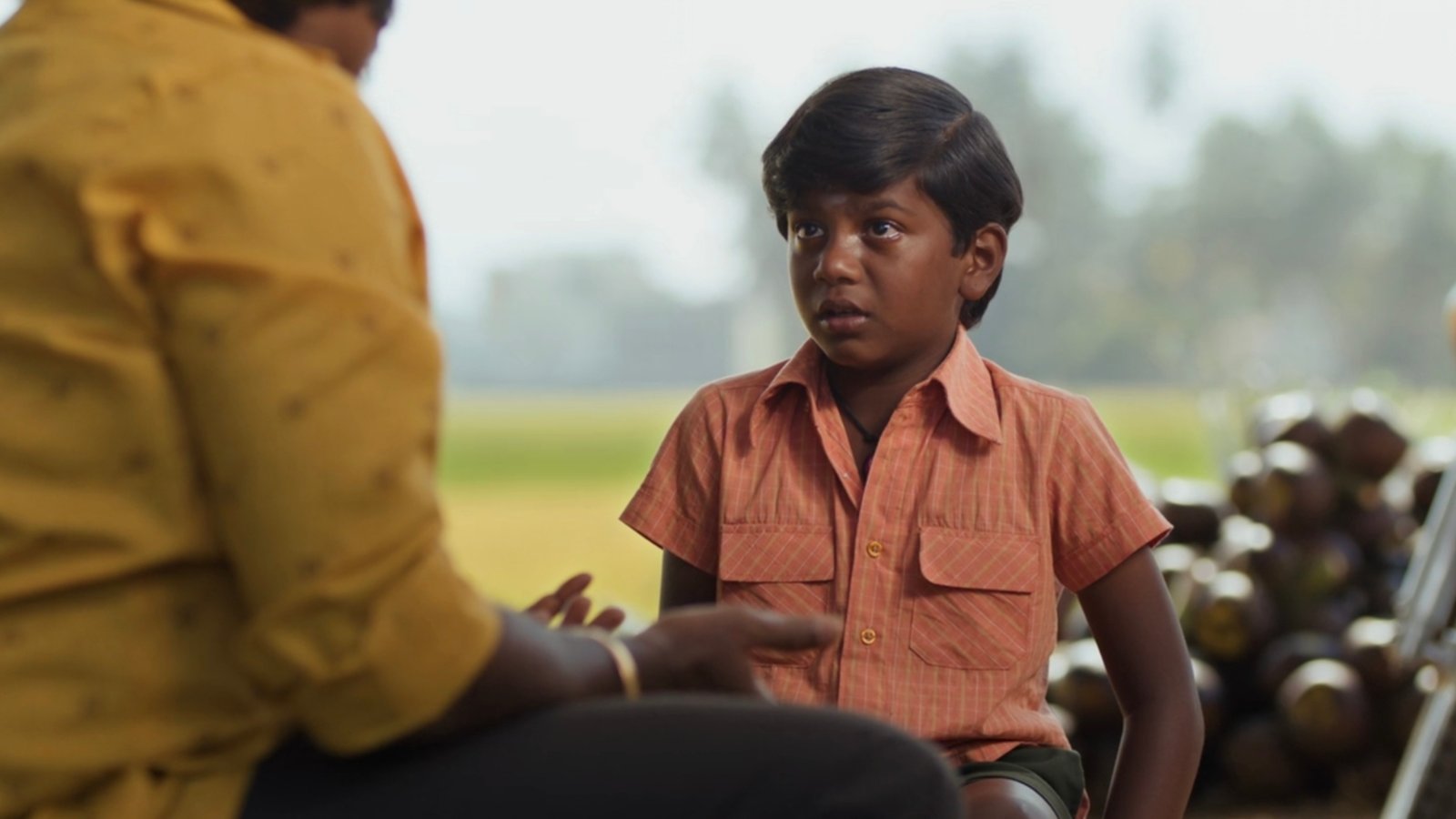
Then comes a scene where Sabari confesses to Baththa that it was he who had locked him in. It’s an incredible scene, absolutely heart-melting.
Baththa eventually reveals that the reason he went there was to sing. As a child, people used to laugh whenever he sang; that fear and humiliation turned him into a thug. To ensure no one would ever mock him again, he gave up singing and cultivated an image that made him untouchable; no one dared to make fun of him.
The Song That Finally Set Baththa Free
In the end, Sabari encourages Baththa to sing at Thenu’s ceremony. Initially, the crowd disapproves, but upon witnessing his sincerity, they begin to applaud. While the performance may not have been technically perfect, it was filled with profound emotional truth.
The audience becomes deeply moved, witnessing a fearsome man publicly confronting his own vulnerability. This marks the culmination of his character arc: a man who became a thug out of fear has, by facing that very fear, reclaimed his humanity. His embrace of Sabari serves as a symbol of this complete transformation.
Baththa finds redemption all because of an eight-year-old child.
What Does “The Door Has Opened” Really Mean?
Furthermore, at the end, a piece of paper is shown with the words “The door has opened.” This wasn’t just about the toilet door; it represented the opening of the doors to Baththa’s ego, his fears, and his humanity.
In real life, this means that sometimes a minor, accidental event or an innocent person can unlock the doors within you. You face yourself, your anger, your loneliness, how you treat your family, your reliance on power or intimidation, all of which are merely temporary.
The things that truly hold value are those you already possess but have failed to notice.
The film teaches us that fear, ego, and the self can act as a prison. True strength does not come from violence, but from acknowledging one’s mistakes and choosing to change.
A touch of innocence can melt even the hardest of hearts. It is a simple story, yet there is deep thought behind every element.
If you have watched the movie, you surely must have felt this.
Do tell me which moment you found the most impactful?