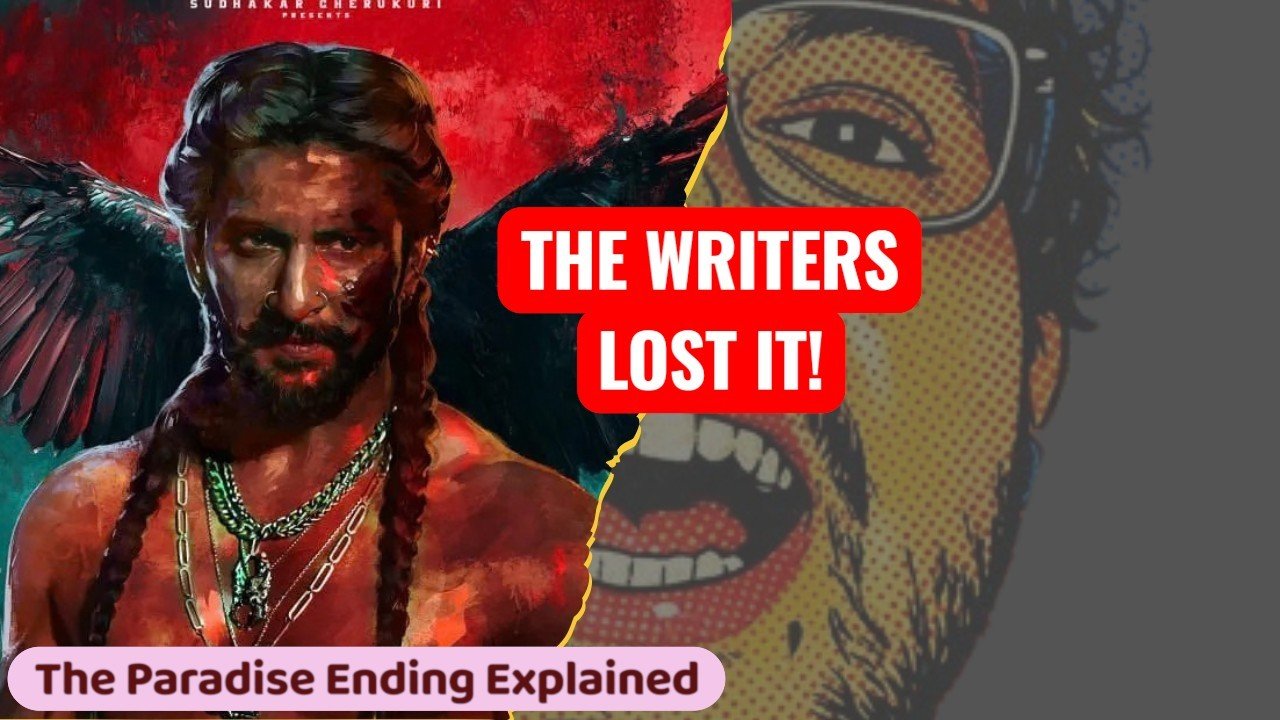
“The Paradise,” a highly anticipated film with a budget of ₹200 crore, has received mixed reviews upon its release. On one hand, audiences are loving it—dancing and celebrating—while on the other, critics are literally tearing it apart.
Here, we’ll take a deep dive into what actually went wrong with the movie and explore why the villain shot both his father and himself in the climax.
Spoiler Warning: If you haven’t seen the movie yet, stop reading this article right now. Go and watch the movie first; then it will make sense for you to read this article. But if you still want to stay connected with this article, then proceed at your own risk.
The Paradise Review: What Went Wrong With the Story?
The story begins with the Savari tribe, which is under the complete control of Malik.
We are introduced to the main villain, Shikanja Malik, before the hero appears. Then there is Shikanja Malik’s son, Vikram Malik, played by the incredibly talented dancer Raghav Juyal.
Together, they treat the entire tribe like slaves and subject them to torture.
The story opens with Chapter One: “The Worm of Scars.”
Our hero’s mother, Sammakka, was pregnant with twins, but due to the atrocities committed by Shikanja, one child died; the other—our hero, Jadal—survived.
Now, pay close attention—this is where the mistake in Chapter One comes into play.
Jadal’s identity is linked to his deceased twin sister—a plot point we will get to in the second half. But what caused the rift between the mother and son?
In his childhood, Jadal was caught stealing biryani. The villain, Shikanja, decided to make an example of him to send a message to everyone: “Don’t steal; you must live under my heel.”
Shikanja publicly humiliated both Jadal and his mother. He taunted Jadal, claiming, “Your mother slept with me last night—go ask her.”
Consequently, our hero began to hate his mother and eventually became estranged from her. During this time, he found a dog and grew attached to it, but Vikram—the son of the villain, Shikanja—bullied him over it.
Amidst this torment, Jadal lashed out and injured someone, for which he was sentenced to 14 years in prison.
When the hero emerges from prison after fourteen years, he has completely transformed; he has turned into a raw, dangerous, and brutal machine.
The Paradise’s Biggest Problem: Jadal’s Mother-Son Conflict
The movie’s biggest problem is that it offers absolutely no explanation. He returns after 14 years, yet he remains just as resentful toward his mother.
There is no attempt to justify or clarify the misunderstanding from his childhood—where he believed she was a sex worker—or to explain whether it was a matter of her having no other choice.
Or perhaps the guy is just such a massive idiot that he spent years believing his mother was a sex worker simply because someone told him so.
Let’s assume, for the sake of argument, that the mother and son are complete morons; still, no one else ever tries to tell them, “Bro, that’s not the case. Your mother isn’t a sex worker.”
Now, let’s move on to an even worse twist in the movie—the kind you find in every other Telugu mass masala flick.
You will see just how repulsive and crude the filmmakers were in forcibly shoehorning a sexual element into the movie.
Chapter 2: The Butterfly and the Forced Sexual Angle
Subbu is introduced as a character whose mother is drowning in debt and facing threats from creditors.
Realizing that people throw money around when they see a heroine’s naked body on screen, she decides to make B-grade movies. She tells her mother about this plan, and her mother simply says, “Hey, I’ll handle the camera.”
Ugh, the makers portrayed this sordid business so casually, as if it were something that happens in every other household.
If your mind hasn’t been blown yet, just wait—there’s more absurdity in store.
Jadal meets Subbu and falls in love with her. Poor Jadal—our saintly soul—remains completely unaware of Subbu’s profession; she never tells him. However, one day he visits her home. He realizes the truth, and that’s exactly when our hero’s heart breaks.
That chapter ends there, and with it, the hero’s primary job—to seduce the audience—comes to a close.
After this, the movie never really returns to the heroine. It’s as if the makers thought, “Job done; we showed what we wanted to show, didn’t we?”
Honestly, if they had just deleted that entire ‘butterfly’ chapter from the movie, it wouldn’t have made a damn bit of difference.
Chapter 3: The Mother’s Sacrifice Finally Comes to Light
This is where that emotional twist comes in—the one they hurled with such force that it hit me right in the gut.
Jadal discovers that his mother, Sammakka, isn’t the kind of woman he had imagined her to be. Back in his childhood, the villain had poisoned his mind against her; he had even branded him with the label “Son of a Whore.”
Then comes the emotional scene. Everything his mother did was for her son’s sake. Jadal finally realizes that she had made a genuine sacrifice for him all those years ago.
Seriously, Jadal, you moron—what were you doing while rotting in jail for 14 years? Didn’t it occur to you back then that your mother had made a sacrifice? And as for the mother—she didn’t say a word about it either. Do you know what explanation she gave for keeping quiet?
“I thought that if I told you, you might end up doing something rash.”
Chapter 5: The Paradise, Jadal’s Resurrection and the Chaos
Now, let’s move on to Chapter 5, titled “Paradise.”
My blood pressure is rising as the story progresses, so please bear with me.
Here, Jadal rallies his people, urging them to awaken their conscience. He points out the hurdles: “We don’t have SIM cards; for a SIM card, we need an Aadhaar card; and for an Aadhaar card, we need citizenship.”
Jokes aside, everyone needs an identity.
There is a sumo-style government employee from Japan who is willing to support them, but the villain, Shikanja Malik, bumps him off.
Speaking of being bumped off—in this very chapter, our hero was also killed; he was strung up with a noose around his neck.
But hey, if the hero of a South Indian mass-masala movie doesn’t come back to life after dying, then what kind of South Indian movie is it? Who would even watch such a film?
Jadal’s favorite dog comes running over and sprinkles *kumkum* and turmeric onto the idol of the Goddess. Thunder rumbles. Rain begins to pour. A single drop of water falls on Jadal’s head, and Jadal be like: bolne lagi means—he comes back to life.
By this point, the movie was really getting on my nerves—I even started bickering with my brother right there in the theater, tossing orange candies at each other. During the interval, I had actually decided to just go home, but he kept me there with false hope, saying, “Just watch, ‘Nani’ is going to kill it—don’t underestimate ‘Nani’, bro.” Here’s my full review of the movie The Paradise.
So, if you actually remember the movie up to this point, it means you were still alive through it all.
The Paradise Ending Explained: Why Did Shikanja Kill Himself?
Now, let’s get into the explanation of the ending—keep your ears open, bro.
Chapter 6 The Worm of War
I discovered that the writer never actually had an ending in mind. They just kept writing, only to realize later—”Oh, wait, this isn’t a Season 1 or Season 2; it’s a movie.”
Normally, what happens in almost every other movie? The hero fights the villain, and in the end, the hero kills the villain.
The director here…
The makers were so lazy that, by the time they reached the climax, they literally had the villain shoot his own father and then shoot himself.
And what was the justification given for this?
The people of the ‘Savari’—this so-called lowly tribe—had finally gained their identity. The villain declared, “I cannot bear the thought of them securing their identity while I am still alive,” and proceeded to shoot himself.
By the way, this is the same villain who had single-handedly incapacitated the hero, gradually paralyzing him. He was a karate champion, yet he ended up shooting himself.
Now, you tell me—how is anyone supposed to digest a climax scene like that?
In this very chapter, there’s a newborn baby—barely a few hours old—that they are hauling around frantically. The baby gets tossed from a height—falling, falling, falling—only to be caught at the last second. Good grief!
A Great Concept Ruined by Poor Execution
The movie’s concept was fantastic, but the execution was flawed.
It had immense potential, but it was marred by excessive nonsense, brutal gore, and hyper-fast editing—seemingly designed to prevent your brain from registering the sheer absurdity unfolding on screen.
The editing was very fast in some places, while in others, the slow-motion sequences were so drawn out that you’d find yourself thinking, “Go ahead and finish your slow-motion shot; we’re not going anywhere—we’re right here in the theater.”
You could have a natural-born superstar, but if the screenplay and story are rubbish—well, even if God himself descended and performed a cosmic dance, not even He could save the film.
By the time the movie ended, it might well have signaled the death knell for the ‘mass masala’ genre in the Telugu film industry.
I hope I’ve managed to clear up some of the confusion regarding where exactly this movie went wrong.